MelonNote’s AI tutor lets you ask questions about your study material. It is most useful when you bring a specific point of confusion: a definition you cannot explain, a contrast you keep mixing up, or a step in an example that does not make sense.
A useful session ends with you explaining the idea independently. Reading a polished answer can feel productive without showing whether you can use it. This guide keeps the conversation tied to a source and a concrete learning task.
Prepare the note before the conversation
Import or record the relevant material, then check the text against its source. If a transcript has the wrong technical term or an image extraction has lost a negative, the tutor may build an explanation on that error.
Give the note a clear topic. If you are asking about one lecture, start there. If your question genuinely connects several lectures, use the app’s multi-note study workflow and select only the material needed for that comparison.
Decide what a useful answer would help you do. “Understand chapter four” is broad. “Explain why this example is a confounding variable rather than a mediator” gives the conversation a target.
Ask from your current understanding
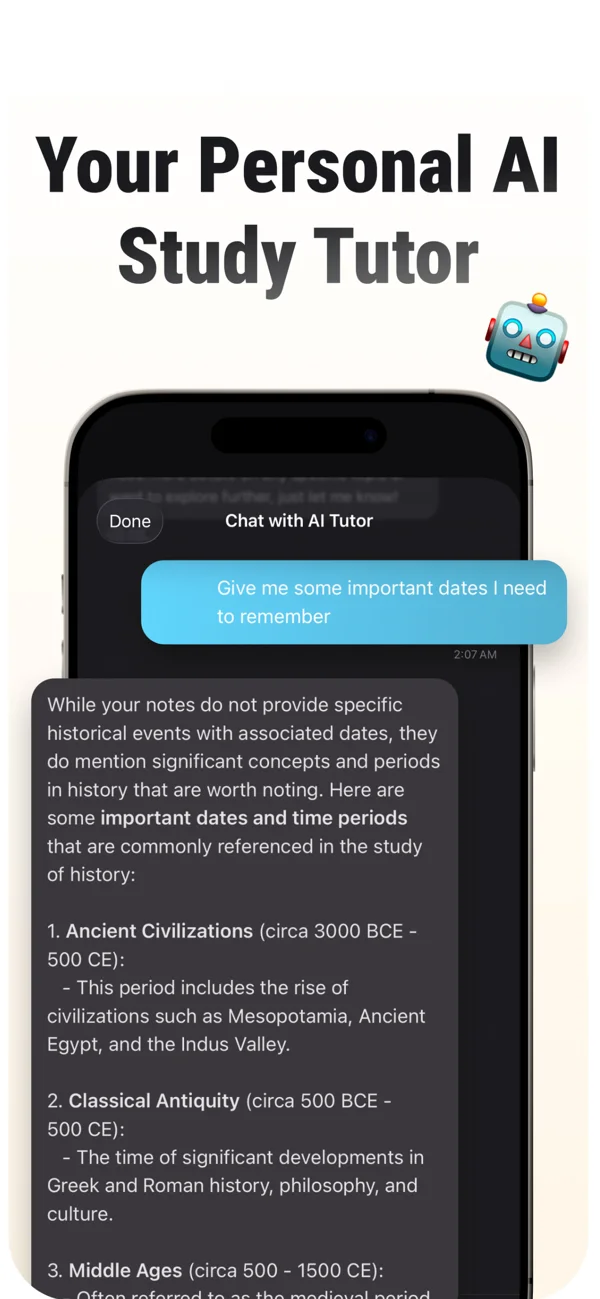
Open the note’s tutor or chat option. Include what you think the concept means and where your reasoning stops. That gives the tutor more to work with than a request to summarize everything again.
For example:
I think a confounding variable affects both the possible cause and the outcome. In this example, I cannot tell whether the third variable is a confounder or part of the mechanism. Walk through the distinction using the note, and say whether the note provides enough information to decide.
This is an illustrative study prompt. It does not guarantee the response will be correct or that the app will produce formal citations. Keep the original course material available for checking.
Use a different question for each problem
If the problem is terminology, ask for a plain-language definition followed by the course term. If the problem is a comparison, ask for the distinguishing features and a boundary case. If the problem is application, supply an example and explain your attempted answer.
For a long explanation, ask for a small sequence rather than a wall of text. “Explain the first step and why it is needed” is easier to evaluate than “Explain the entire topic in detail.” You can follow up once that first step makes sense.
Avoid asking for certainty the source cannot provide. If the note gives competing interpretations, ask the tutor to separate them rather than select a winner without evidence.
Verify claims against the source
Check definitions, numeric values, named theories, and any claim that was not in your original understanding. AI can produce plausible explanations that are incomplete or inaccurate. An answer’s confident tone does not establish its reliability.
When the response appears to go beyond the note, make the distinction explicit in your own study record. You might write “course source says X; additional explanation to verify says Y.” That prevents helpful-looking background from becoming an unsupported course fact.
If an answer conflicts with your textbook or teacher, inspect the disagreement instead of automatically accepting either wording. Sometimes terms differ by context; sometimes the generated answer is simply wrong. Ask a qualified person when the distinction remains unresolved.
Test the explanation without the chat
Close or cover the answer and explain the idea aloud. Use your own example if possible. Then compare your explanation with the source-backed reasoning.
A practical three-part test is:
- State the concept in one or two sentences.
- Explain a case where it applies.
- Explain a similar case where it does not apply.
The third step often reveals a missing condition. Knowing that two concepts are related is easier than knowing where one stops and the other begins.
Use a quiz or flashcards for follow-up practice, but keep application tasks in the routine. A correct recognition answer does not always mean you can produce the explanation independently.
Keep the conversation manageable
Work on one uncertainty at a time. If a response introduces several new terms, return to the original question and ask for the smallest explanation that resolves it. Save a brief takeaway in your own study notes rather than treating the entire chat as a finished textbook.
For cross-topic revision, combine related notes and ask how the ideas connect. Explain the purpose of the comparison so the conversation does not drift into a broad overview.
The AI tutor prompt collection offers examples for definitions, comparisons, examples, and self-testing. Adapt them to your material and check the output each time. The app is a study companion; the final reasoning should still be yours.
Check generated material against your original notes. App features, access limits, and screen labels can vary by platform and version.
Put this into practice.
Start with one useful note in MelonNote. Turn it into questions you can answer, ideas you can explain, and a reason to come back tomorrow.
Free download. In-app purchases available.