
To take notes on a research paper, separate the research question, study design, results and limits of the conclusion. Give each important claim a source location, and distinguish what the authors observed from how they interpreted it. Your notes should help you explain and evaluate the paper, not simply shorten its paragraphs.
Start with the purpose of the reading. Are you preparing for a seminar, learning a method, comparing studies or gathering evidence for an assignment? That purpose determines which details deserve the most attention.
Make a first pass through the paper's structure
Read the title and abstract, identify the section headings, and inspect the figures and conclusion. Write a provisional sentence about the question the paper addresses. Then read the sections needed to check that sentence.
This first pass is orientation. It does not replace reading the methods and results when your task is to evaluate a claim. Duke's scientific reading tips offer a practical way to approach a paper, while Trent University's guide explains the roles of its major sections.
Keep unfamiliar terms in a small glossary. Look up the terms that affect the central question or method first. You do not need to stop at every unfamiliar phrase before understanding what the study is trying to do.
Use a claim-evidence-limit table
Download the research-paper notes template. Start with this structure:
| Field | What to record |
|---|---|
| Citation | Authors, year, title and a stable link or DOI |
| Question | What uncertainty is the study trying to address? |
| Design | Who or what was studied, what was compared, and how? |
| Outcome | What was actually measured? |
| Evidence | The result, table or figure relevant to the claim |
| Limit | What does that evidence not establish? |
| Next question | What do you still need to clarify or compare? |
Record page numbers or section names as you go. “The paper says this somewhere” will make later verification much slower. If you write a direct quotation for an assignment, mark it clearly as a quotation and follow the citation requirements of your course.
A worked example from a published paper
Ritchie, Della Sala and McIntosh's 2013 study of retrieval practice and mind mapping provides a useful example. It is openly available under a Creative Commons Attribution license. The entries below are our short paraphrases; consult the paper for its complete methods and results.
| Field | Example note | Where to verify |
|---|---|---|
| Participants and task | Children aged 8–12 learned geographical facts | Abstract and Methods |
| Design | Two experiments compared retrieval practice and mind mapping conditions | Introduction and experiment methods |
| Result | Retrieval practice benefited later fact recall; mind mapping had no consistent effect | Abstract and Results |
| Timing | Experiment 1 assessed recall after four days; Experiment 2 used one- and five-week tests | Abstract and procedures |
| Boundary | These results concern the tested children, material and procedures; they are not a test of MelonNote or every possible study task | Study design and discussion |
Notice that the final row is a limit on our interpretation. It prevents a study about a particular learning task from turning into a blanket promise about an app or an exam result.
Read a figure as an argument you can check
Before copying a chart into your understanding, identify its axes, units, groups and time point. Read the caption and find the part of the methods that explains how the values were produced.
Then write one sentence describing the visible comparison and another describing what you cannot conclude from that comparison alone. If the chart includes uncertainty bars, check how the paper defines them rather than assuming they represent one particular statistic.
You do not have to redraw the paper's figure for this exercise. A compact description with a figure number can be enough. If a visual detail is central to the claim, return to the original figure instead of relying on extracted text.
Keep observation and explanation separate
Use two columns in your notes when necessary: “reported result” and “possible explanation.” The results section may establish a pattern; the discussion may propose a mechanism or relate it to previous work. Those are different contributions.
If the authors write cautiously, preserve that caution. “May explain” should not become “proves.” Likewise, a result described as statistically significant does not by itself tell you whether the effect is large, useful in a different context or free from design limitations.
When you cannot judge a statistical or methodological detail yet, mark it as a question. A note that honestly identifies a gap is more useful than a confident sentence copied from a tool.
Use MelonNote for source-based questions
Import the assigned PDF into MelonNote and inspect the resulting note. Check headings, tables, formulas and figure references. Use the summary to orient yourself, then return to the original paper for the evidence behind each claim.
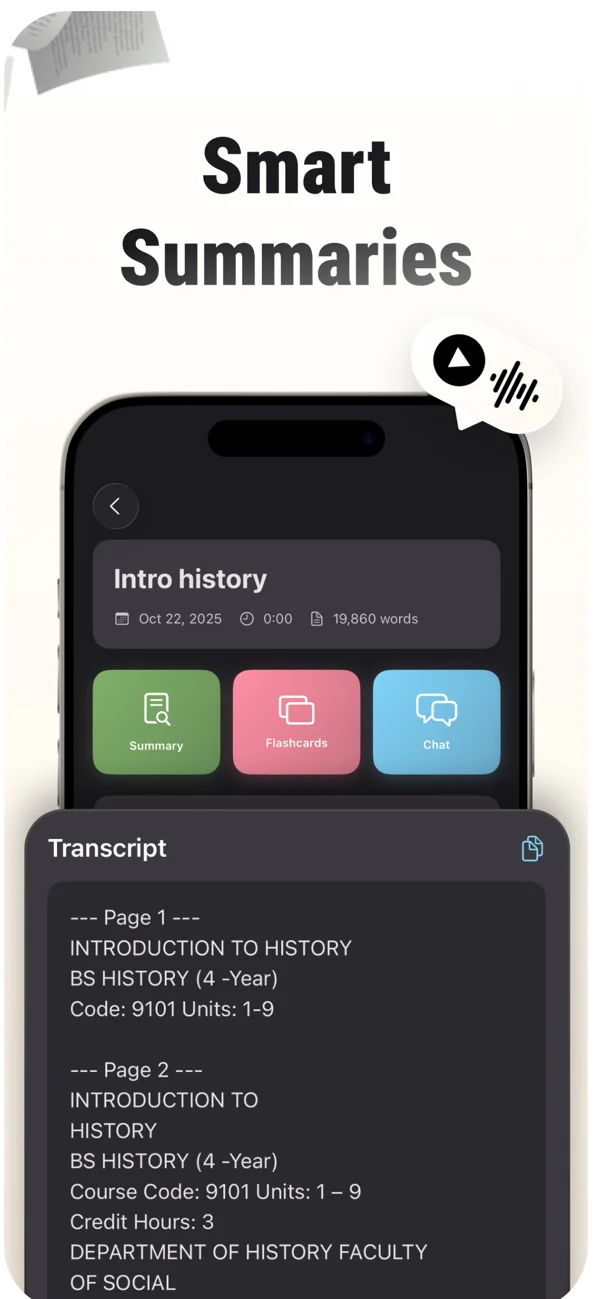
An App Store screenshot showing a note and its study tools. Keep the original source available while reviewing summaries, cards and tutor explanations.
iPhone and Android · Features and screen layouts may differ.Ask the tutor one precise question, such as: “What is the difference between the outcome measured here and the broader conclusion discussed by the authors?” Include the relevant context in your note, and verify the response against the actual sections.
The AI tutor guide explains how to inspect answers. This workflow does not assume automatic literature searching, reliable generated citations or a citation-manager integration.
Work through one paper, one question at a time.
Import your assigned PDF into MelonNote, review the note, and use focused tutor questions to clarify the parts you still need to understand.
Free download. In-app purchases available.
Prepare questions for the seminar
Finish your notes with three prompts: one about the main result, one about the method and one about the boundary of the conclusion. For example: “What comparison answers the research question?” “How was the outcome measured?” “Which new context would need separate evidence?”
Try answering without looking, then check the table. If you can list facts but cannot explain how the design addresses the question, return to that relationship rather than generating more flashcards.
Compare papers only after checking each one
When two papers address a similar question, compare participants, tasks, measures and timing before treating their conclusions as a disagreement. A different result may reflect a different question or design.
Use the combined-notes workflow to study related sources, but keep their citations and claims distinct. For long documents, the PDF study routine helps you work in manageable sections.
A good research note lets you state what the paper asked, how it investigated the question, what it found and how far the conclusion can reasonably travel. That is a stronger foundation for class discussion than a polished summary with no traceable evidence.
Check generated material against your original notes. App features, access limits, and screen labels can vary by platform and version.
Work through one paper, one question at a time.
Import your assigned PDF into MelonNote, review the note, and use focused tutor questions to clarify the parts you still need to understand.
Free download. In-app purchases available.