To summarize a textbook chapter, identify its central question, write the main point of each relevant section in your own words, and connect those points into a short explanation. Check the result against the chapter, then add a few questions you should be able to answer. A useful summary preserves the argument and its conditions, not just the vocabulary.
The one-page format below is an organizing constraint, not a rule about how much every chapter should shrink. A technical chapter may also need worked problems or diagrams that belong on separate pages.
Preview the chapter before collecting details
Read the title, learning objectives, headings and conclusion. Look at the figures and worked examples. Write one sentence describing what you are expected to understand after the chapter.
For an illustrative chapter about urban tree cover, that question might be: “How can tree cover influence a street environment, and what limits the conclusions we draw from observations?” This question is more useful than “trees,” because it tells you which relationships your summary must preserve.
The Carnegie Mellon textbook-reading guide offers a structured approach to working through textbook material. Use the chapter's structure as a map, then read the sections needed for your course task.
Separate the main point from its illustration
For each section, write its main claim and one example or piece of evidence. Keep them separate. An example can explain a principle without proving that the principle holds in every setting.
In our original teaching scenario, one street has more trees and is cooler during a particular observation. Your note should not immediately become “planting trees always reduces every street's temperature by the same amount.” You would need to examine measurement conditions and other differences between the streets.
This distinction matters in many subjects. A worked calculation illustrates a method under certain assumptions. A historical episode illustrates an argument in a particular context. A case study provides evidence about the case studied.
Copy the one-page chapter summary template
Download the plain-text chapter summary template, or copy this layout into your preferred notes tool:
CHAPTER / AUTHOR / SOURCE PAGES:
COURSE QUESTION:

MAIN ANSWER IN 2–4 SENTENCES:

THREE TO FIVE SUPPORTING IDEAS:
1. Idea — source section — example or evidence
2. Idea — source section — example or evidence
3. Idea — source section — example or evidence

IMPORTANT CONDITION OR EXCEPTION:
KEY TERMS I MUST DEFINE:
DIAGRAM / WORKED PROBLEM TO PRACTICE SEPARATELY:

QUESTIONS I CAN ANSWER WITHOUT LOOKING:
ONE UNRESOLVED QUESTION:
The source fields make the summary easy to verify later. The unanswered question makes it useful for your next study session. Do not spend more time adjusting the template than thinking about its contents.
See a completed miniature example
The example below uses an invented chapter outline to demonstrate the format. It is not an empirical finding or a summary of a particular published textbook.
| Field | Example entry |
|---|---|
| Course question | How should we interpret a comparison between two streets with different tree cover? |
| Main answer | Describe the observed difference, then examine how it was measured and which other factors differ. A comparison can suggest a relationship without isolating a single cause. |
| Supporting idea 1 | Measurement conditions: time, weather and measurement location affect what was observed. |
| Supporting idea 2 | Comparison: traffic, surface materials and buildings may also differ. |
| Supporting idea 3 | Scope: a result from one place and occasion does not establish every other setting. |
| Practice question | What additional information would make this comparison easier to interpret? |
| Unresolved question | How would the course's proposed study design address the competing explanations? |
The summary keeps an argument, rather than just a list of terms. It also avoids inventing a numerical result that the source does not provide.
Draft from understanding, then check coverage
After reading a manageable section, look away and explain its point. Reopen the source to check what you missed or changed. If you cannot explain it yet, identify the specific sentence, term or step causing difficulty.
Then check your summary against the chapter map. Are the important sections represented? Did you preserve exceptions and uncertainty? Did a memorable example crowd out the central concept? The college guide to summarizing discusses combining section-level summaries into an account of the whole text.
Avoid requiring every paragraph to contribute one sentence. That can preserve the chapter's length in miniature while losing its hierarchy.
Use MelonNote to support the first draft
If your chapter is available as a PDF you are permitted to process, import a focused section into MelonNote. Review the resulting note, then use its summary to orient yourself. Compare the summary with the chapter rather than assuming every important condition survived.
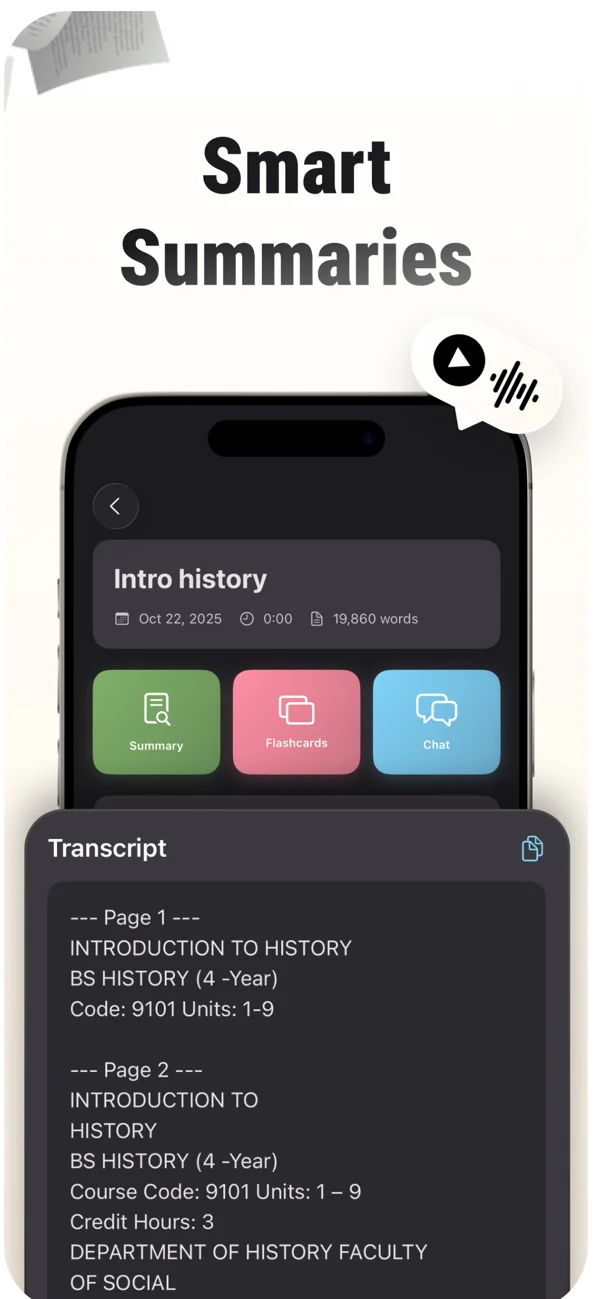
An App Store screenshot showing a note and its study tools. Keep the original source available while reviewing summaries, cards and tutor explanations.
iPhone and Android · Features and screen layouts may differ.Use the template to organize what you will actually study. You can ask the AI tutor to explain a confusing relationship or identify which part of a question is unsupported by your note. Verify new factual claims in the original source.
Start with one chapter, not the whole textbook.
Bring a focused PDF into MelonNote, review its summary, and turn the ideas you need to remember into practice questions.
Free download. In-app purchases available.
Turn the summary into something you can retrieve
Write a definition question, a relationship question and an application question. For the street example, these might test what was measured, why a comparison alone leaves uncertainty, and what information would help interpret a new case.
Use MelonNote's flashcards for focused prompts and its quiz workflow for a short check. If your assessment requires calculation or extended writing, also practice those tasks. A concise summary cannot replace every form of preparation.
When one page is the wrong constraint
Keep proofs, derivations, complex timelines and labeled diagrams as separate practice resources when compressing them would hide necessary steps. The summary can point to those resources with a source reference.
If the chapter spans several largely independent topics, make separate summaries and connect them with a topic map. Our long-PDF study guide helps you choose manageable sections, and the study-guide workflow connects the resulting summaries and questions.
You have a useful chapter summary when it lets you explain the main answer, find the supporting source and choose a sensible next task. A beautiful page that cannot do those jobs needs revision.
Check generated material against your original notes. App features, access limits, and screen labels can vary by platform and version.
Start with one chapter, not the whole textbook.
Bring a focused PDF into MelonNote, review its summary, and turn the ideas you need to remember into practice questions.
Free download. In-app purchases available.