
The Feynman technique is a study exercise built around explaining an idea in simple terms, noticing where your explanation breaks down, checking the source and trying again. A good Feynman technique example should show that revision process, not just present a polished final paragraph.
The University of Colorado Boulder's guide describes using explanation to work through understanding. Here we apply that approach to an original, simplified example about averages. The example is an editorial exercise, not an app-generated result or a claim about a measured learning improvement.
Pick one concept with a clear boundary
Choose a question small enough to explain in a few sentences. “Statistics” is too broad. “Why can the mean and median tell different stories about the same numbers?” is specific enough to inspect.
Find the relevant definition or worked example in your course material. Keep that source available, but make your first explanation without reading it. You are trying to expose your current understanding, including the gaps.
Write down who the explanation is for. A classmate who knows arithmetic but has not studied averages is a clearer audience than “everyone.” Simple language should remove unnecessary jargon while preserving the concept.
Make an honest first attempt
Suppose your first explanation is:
The mean and median are both the middle. The mean is usually better because it uses all the numbers. The median is for when the data is wrong.
This sounds confident but contains several problems. “Middle” is ambiguous. “Better” has no stated purpose. An unusual value is not necessarily incorrect. The explanation needs a concrete example and more careful conditions.
Do not erase this attempt immediately. It records the misconception you need to repair. If you replace it with a textbook sentence too quickly, you may lose track of what changed in your understanding.
Use numbers small enough to inspect
Consider the ordered values 2, 3 and 10. Their mean is (2 + 3 + 10) / 3 = 5. Their median is the middle ordered value, 3.
Now replace 10 with 100. The mean becomes 35; the median remains 3. This does not mean 100 is a mistake. It shows that the two summaries respond differently to this change.
| Question | Observation | What it helps explain |
|---|---|---|
| How is the mean calculated? | Add the values and divide by their count | It depends on the magnitude of every value |
| How is the median located here? | Order the three values and choose the middle | Its value stays 3 in these two examples |
| Which summary is “better”? | The calculation alone does not decide | The purpose and distribution matter |
This is an introductory example. Your course may discuss other properties and situations, including even-sized datasets. Add those conditions when they become relevant to the question you are trying to answer.
Mark the exact gap
Compare your first explanation with the example. You might write:
- I used “middle” for two different procedures.
- I assumed a large value must be an error.
- I called one measure better without specifying what I wanted to describe.
These are useful repair targets. “I don't understand averages” is too broad to guide the next action. Return to the relevant course definition and check each statement separately.
Use an AI tutor for a focused follow-up
In MelonNote, open the note containing your source and ask about one part of your attempted explanation. A useful prompt is:
I said that the median is only useful when data is wrong. Explain why that statement is too broad using the definitions in this note. Ask me one follow-up question before giving another example.
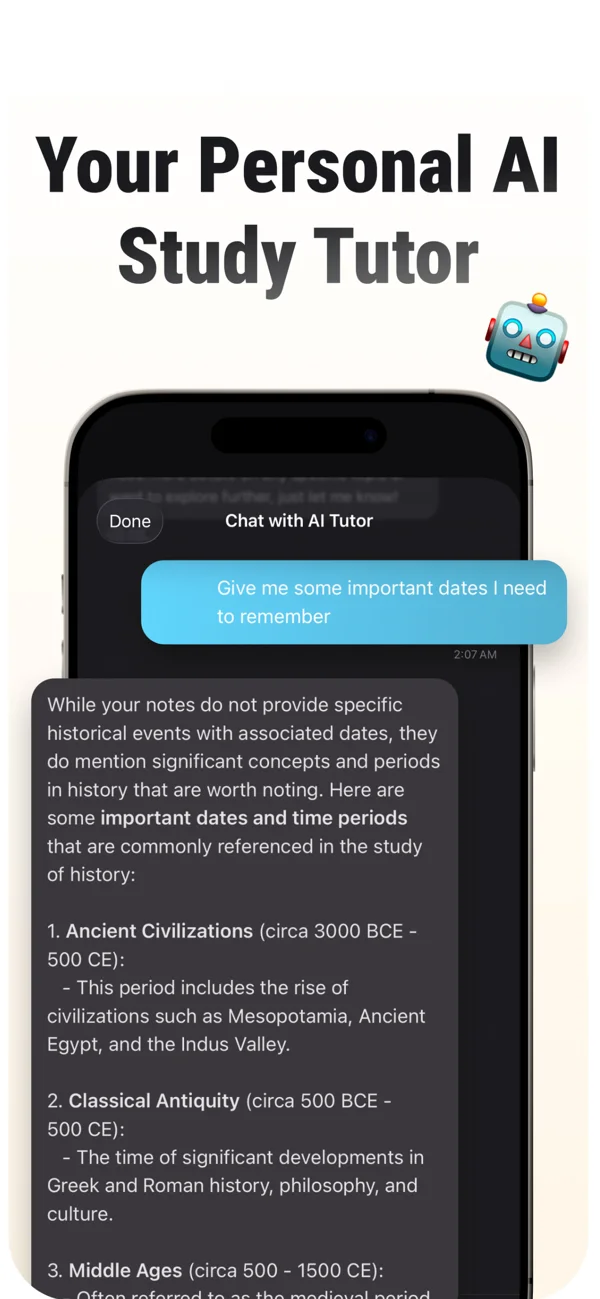
An App Store screenshot of MelonNote’s AI tutor. The conversation shown is sample content. Verify factual explanations in your own course sources.
iPhone and Android · Features and screen layouts may differ.Check the explanation against the source, including every calculation. A fluent response can still introduce a wrong condition. Our AI tutor guide explains how to keep the conversation anchored to the material you are studying.
Find the gap in your explanation.
Bring your source into MelonNote and ask the tutor a focused question. Check the answer, then explain the concept again yourself.
Free download. In-app purchases available.
Write a second explanation in your own words
An improved version might be:
The mean adds the values and divides by how many there are. The median uses the ordered position in the data. In 2, 3 and 10, the mean is 5 and the median is 3. Changing 10 to 100 moves the mean to 35 while the median stays 3. Neither calculation tells us that the large value is wrong; choosing a summary depends on what we want to describe.
The second explanation is still simple, but it defines the procedures, uses a checkable example and avoids an unsupported universal claim.
Keep a note of the change: “I now distinguish the calculation from the purpose of using it.” That is more useful than merely declaring the topic complete.
Test the explanation with a new case
Close your notes and try 4, 5 and 6. Explain why the mean and median agree there. Then change 6 to 60 and predict what will happen before calculating it.
If you can only repeat the original example, revisit the definitions. If you can predict and explain the new case, move to the next condition your course requires. The active-recall routine can help you revisit the repaired concept later.
Keep simplification honest
An explanation can be short and still preserve necessary terms. Do not replace a technical concept with an analogy that changes its meaning. If you use an analogy, state where it stops working.
For a complex topic, create several small explanation exercises and then connect them. Use a diagram or worked problem where words alone are insufficient. The point is not to make every subject sound elementary; it is to make your reasoning explicit enough to inspect.
You can reuse the explain-check-revise worksheet for another concept. Keep the first attempt, the source correction and the new example together so you can see what you have learned and what still needs work.
Check generated material against your original notes. App features, access limits, and screen labels can vary by platform and version.
Find the gap in your explanation.
Bring your source into MelonNote and ask the tutor a focused question. Check the answer, then explain the concept again yourself.
Free download. In-app purchases available.