
To prepare for an oral exam, turn your learning objectives into questions, answer them aloud without reading, and practice follow-up questions that test your reasoning. Compare your answers with your notes and the assessment criteria, then rehearse the parts that were unclear.
Silent recognition is not the same task as explaining an idea to another person. Your preparation should include speaking, organizing an answer and responding when the question changes. MelonNote can help you work with the source material and prepare prompts; the spoken rehearsal is something you do yourself.
Clarify the format before choosing practice tasks
Find out whether the exam involves a presentation, unseen questions, a discussion, a demonstration or a combination. Check the time allowed, permitted notes and expected depth. Use official instructions and any examples provided by the course.
The Western University oral exam preparation handout discusses preparing for the actual examination task. Use your course objectives to decide what to rehearse rather than building a generic bank of hundreds of questions.
For each major topic, identify whether you must define, explain, compare, apply or critique. Those verbs suggest different prompts and different standards for a complete answer.
Build a question ladder
A useful rehearsal moves from a basic explanation to a boundary or application. Here is an original example for a research-methods topic:
| Level | Practice question | What you are checking |
|---|---|---|
| Define | What is the difference between a population and a sample? | Clear terminology |
| Explain | Why does recruitment matter when interpreting a survey? | A connected explanation |
| Apply | What can a survey of volunteers from one club tell us about the university? | Use of the scenario's details |
| Challenge | Would more replies through the same recruitment route resolve the limitation? | Conditions and counterarguments |
| Extend | What additional information would you need to judge the claim? | Awareness of uncertainty |
The ladder avoids memorizing a single polished speech. If you can only answer the first question, you know which kind of practice is still missing.
Give your answer a recognizable structure
Begin with a direct answer. Explain the reasoning, add an example if useful, and state a relevant limitation. This sequence gives the listener a route through your thinking.
For the recruitment question, an outline might be:
Answer: recruitment affects who can be represented in the responses.
Reason: the people reached and the people who respond can differ from the target group.
Example: a club-only survey misses students outside that club.
Limit: I would need more design information before judging the size of the problem.
Use the outline as a rehearsal aid, then explain it without reading. If you lose the thread, simplify the structure before adding more detail. A fluent answer that never addresses the question needs a different repair from an accurate answer delivered hesitantly.
Rehearse aloud and capture specific feedback
Choose one question. Give yourself an attempt without looking at your notes. If appropriate, record your own practice on a device so you can listen back. You can also ask a study partner to use the checklist below.
| Check | Evidence to record |
|---|---|
| Accuracy | Which statement was correct, incomplete or wrong? |
| Structure | Was the main answer clear before the details? |
| Support | Did the example actually support the claim? |
| Boundaries | Did you preserve conditions and uncertainty? |
| Follow-up | Could you answer a change in the scenario? |
Download the oral-practice feedback sheet. Write one next action after each attempt. “Explain the recruitment limitation before discussing sample size” is more actionable than “be more confident.”
Use MelonNote to clarify the source
Bring the relevant notes or PDF into MelonNote and check the resulting content. Ask the AI tutor about a specific gap in your attempted explanation. For example:
My answer says that a larger sample is automatically representative. Compare that statement with the limitation described in my note. What distinction have I missed, and what should I check in the source?
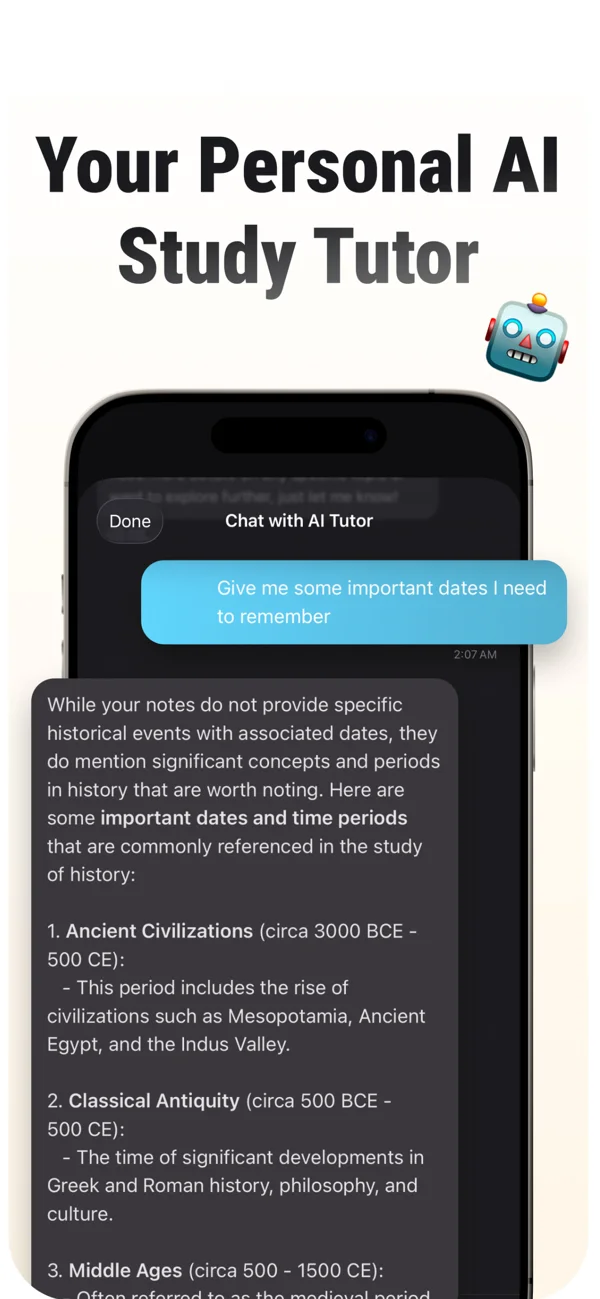
An App Store screenshot of MelonNote’s AI tutor. The conversation shown is sample content. Verify factual explanations in your own course sources.
iPhone and Android · Features and screen layouts may differ.The app screen shows an example tutor conversation. Your subject and answers will differ. Verify any factual explanation in your course material before rehearsing it. The AI tutor guide explains how to keep these questions focused.
Turn your notes into questions worth rehearsing.
Use MelonNote to clarify difficult concepts and prepare focused prompts, then practice explaining the answers aloud in your own words.
Free download. In-app purchases available.
Prepare follow-ups that expose understanding
Ask a partner, or use a text prompt, to change one condition. What if the participants were recruited differently? What if the method's assumption did not hold? What evidence would change your conclusion?
When practicing with AI, request one question at a time and make your own attempt before asking for an explanation. Do not treat a generated follow-up as a prediction of what an examiner will ask. It is a rehearsal prompt to check against your course scope.
Our AI tutor prompt collection includes ways to compare concepts and inspect reasoning. Use those prompts to develop understanding, not to memorize an answer in someone else's voice.
Practice handling uncertainty clearly
If you cannot answer a prompt, identify what is missing. You may know the definition but not its application, or the overall method but not one transition. Return to that part of the source and try again with a new example.
During rehearsal, practice saying which assumption your answer depends on. You can also practice asking for a question to be clarified when its scope is ambiguous. Follow the conventions and instructions for your particular assessment.
Finish with a small mixed session
Mix a familiar question, a difficult question and a new application. Keep the sources closed for your first attempt, then review them. This combines spoken practice with the closed-book check.
MelonNote does not automatically assess your speaking performance in this workflow. Use the feedback sheet, course criteria and appropriate human feedback to judge it. The aim is to make your knowledge accessible in a conversation, while keeping the explanation accurate and responsive to the question.
Check generated material against your original notes. App features, access limits, and screen labels can vary by platform and version.
Turn your notes into questions worth rehearsing.
Use MelonNote to clarify difficult concepts and prepare focused prompts, then practice explaining the answers aloud in your own words.
Free download. In-app purchases available.