
To turn learning objectives into practice questions, identify the action verb, select the supporting course material and create a task that requires that action. “Define,” “explain” and “apply” should not all become the same definition card. Write down what a successful answer must demonstrate before judging your attempt.
Carnegie Mellon's assessment guidance explains why objectives, learning activities and assessments should align. The practical lesson for revision is simple: if the objective asks you to apply an idea, include a new case that requires applying it.
This process helps organize practice. It does not predict the questions your instructor will choose or replace the official assessment guidance.
Break an objective into three pieces
Consider “Calculate average speed for a journey that includes a stop.” The pieces are:
- Action: calculate.
- Content: average speed.
- Condition: the whole journey includes a stop.
A question that asks only “What is average speed?” covers some content but leaves the action and condition untested. Keep those missing pieces visible when planning revision.
For a broader objective, split it into smaller assessable tasks without changing its meaning. If it asks you to “compare and evaluate,” one list of definitions is unlikely to be enough. You may need both a comparison and a justified judgment.
A small source pack for the example
Here is an original introductory note for a mathematical exercise:
Average speed for a whole journey is total distance divided by total elapsed time. If the journey interval includes a stop, that stopped time is part of the elapsed time. Suppose a walker travels 6 kilometres in one hour of movement and stops for half an hour within the journey. The whole-journey time is 1.5 hours, so the average speed is 4 kilometres per hour.
This is a simplified calculation example, not a recommended walking pace or a record of an actual journey. We will use it to design three different tasks.
Match define, explain and apply
| Learning objective | Matching practice question | What the answer must show |
|---|---|---|
| Define average speed | State average speed in terms of distance and time | Total distance divided by total elapsed time, with compatible units |
| Explain the effect of a stop | For the same distance, why does adding a stop reduce whole-journey average speed? | Elapsed time increases while distance remains unchanged |
| Apply the definition | A journey covers 8 km in 2 hours including all stops. Calculate its average speed | 8 ÷ 2 = 4 km/h, using the full stated time |
These are three questions about the same topic, but they demand different evidence of understanding. A correct definition is useful without being proof that you can apply it to a new situation.
Repair a mismatched question
Objective: Calculate average speed for a journey that includes a stop.
Weak question: Which symbol usually represents speed?
The weak question may test notation, but it does not require selecting the correct time interval or performing the calculation. Replace it with:
A walker covers 9 km during two hours of movement and stops for one hour within the journey. What is the average speed from departure to arrival? Show which time you used.
Checked answer: The elapsed time is 3 hours. Average speed is 9 ÷ 3 = 3 km/h. Using only the two moving hours would answer a different question.
The phrase “from departure to arrival” clarifies the interval. If a draft question does not tell you whether a stated duration includes stops, fix the wording instead of guessing the intended answer.
Make the answer criteria visible
Before attempting the question, write the elements you will check afterward. For the application task:
- Select the whole-journey distance.
- Select or calculate total elapsed time.
- Divide with compatible units.
- State the answer with a unit.
If you get the final number right by accident but choose the wrong interval, keep that error in your review notes. Likewise, a calculation error and a misunderstanding of elapsed time call for different follow-up work.
This is a personal practice checklist. Your course's marking scheme remains the reference for how the actual assessment awards credit.
Generate candidate questions in MelonNote
Import a permitted PDF or use a source note you have already checked. In the note's tutor, supply one objective and ask for a draft question that tests its action. For example:
Objective: calculate average speed for a whole journey that includes a stop. Using this note, propose one new practice question. State clearly whether each duration includes the stop. Keep the solution separate so I can attempt it first.
Check both the question and its solution against the source. MelonNote also offers note-based quizzes, but a generated set should be reviewed for objective coverage rather than assumed to match your syllabus automatically. There is no dedicated syllabus parser or exam-prediction claim in this workflow.
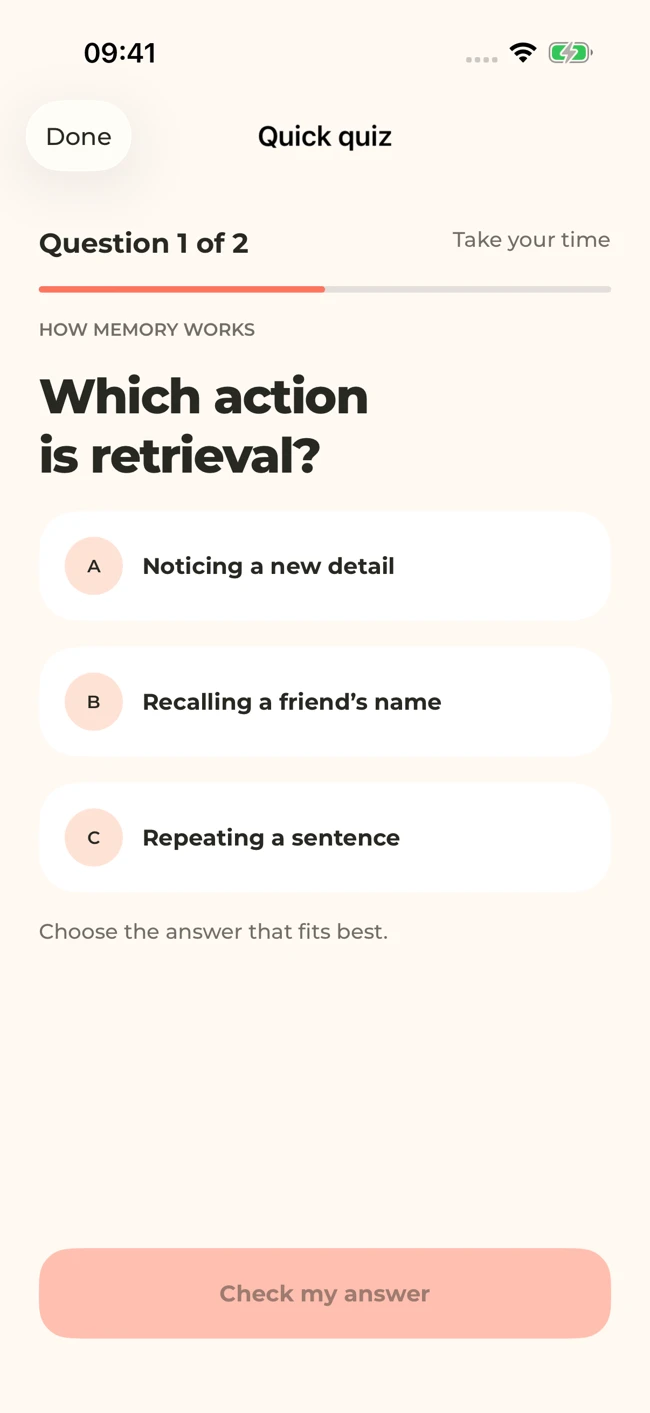
A MelonNote quiz screen with sample memory-study content. Check generated answers against your own source; the worked questions in this article are editorial examples.
iPhone and Android · Features and screen layouts may differ.If the objective concerns a diagram or essay, use an appropriate output. A multiple-choice quiz may help with supporting concepts, while the main practice should still involve drawing the diagram or writing an argument.
Give one learning objective a practical test.
Open your checked course note in MelonNote and ask for a question that matches one objective. Inspect the answer and try it before moving to the next topic.
Free download. In-app purchases available.
Build a coverage table for the whole topic
Use the objective-to-question worksheet or copy this structure:
| Objective | Source location | Question or task | Answer check | Next action |
|---|---|---|---|---|
| Define… | Page or lecture section | Closed-book definition | Required elements | Repair missing term |
| Explain… | Worked example | Explain a relationship | Reason and conditions | Revisit one unclear step |
| Apply… | Rule and example | New case | Method, result and units | Try another case |
Leave a row open when you lack a suitable source. Do not let an AI-generated answer fill that gap without verification. A missing source may be a question for your instructor, a missed lecture to catch up on or a reading you have not yet completed.
Our exam revision plan can help schedule the next actions. Use the table to choose work by the gaps you found, not just by which chapter has the most pages.
Increase difficulty without changing the objective
For the speed example, change the numbers first. Then change the units, such as giving distance in metres and time in minutes, while asking for kilometres per hour. Finally, present unnecessary information and require yourself to identify what is relevant.
Each change adds a demand. Keep a simpler checked example available so you can locate the point at which your reasoning fails. Difficulty should come from the skill you need to practice, not from ambiguous wording or missing data.
Common questions
Can one question cover several objectives?
Yes, but record which part tests each objective. A single long answer can hide a weak subskill. Use a shorter follow-up when you need to inspect a particular step.
What if my course objectives use vague words like “understand”?
Look at the accompanying activities, sample questions and assessment instructions for observable tasks. Ask your instructor for clarification where needed. Do not assume that your interpretation of a broad verb is the official exam scope.
Does a high quiz score mean every objective is covered?
Only if the quiz actually tests those objectives at the required level. Check its coverage and include tasks that require explanation or production. The AI study-guide workflow shows how to keep sources, practice and unresolved questions connected.
Check generated material against your original notes. App features, access limits, and screen labels can vary by platform and version.
Give one learning objective a practical test.
Open your checked course note in MelonNote and ask for a question that matches one objective. Inspect the answer and try it before moving to the next topic.
Free download. In-app purchases available.