
Flashcards for essay exams should help you retrieve arguments, evidence and limitations—not memorize a complete essay word for word. After recalling the material, practice selecting what fits the question and writing a connected answer. A card deck can support that preparation, but it cannot do the writing practice for you.
University of Washington's exam-preparation guidance encourages attention to the kinds of questions and tasks an assessment uses. For an essay, your preparation needs to include explaining relationships and organizing a response, as well as remembering facts.
Give each card a specific job
An essay often requires you to make a claim, support it and address a complication. Those functions suggest several kinds of card:
| Card type | What you retrieve | Why it belongs in essay revision |
|---|---|---|
| Claim | A defensible position with a condition | Helps form a thesis that answers a question |
| Evidence | A specific finding or example and its source | Gives the claim support you can identify |
| Limitation | What the evidence does not establish | Prevents an exaggerated conclusion |
| Counterargument | A serious alternative interpretation | Gives you something substantive to evaluate |
| Selection | Which evidence fits this particular question | Practices relevance rather than recitation |
Avoid a single front that says “Everything about topic three.” You will struggle to judge whether your answer was complete. For basic wording, see our flashcard-writing guide.
A fictional evidence pack for a worked example
Suppose the practice question is: Should a university extend library opening hours? The following sources are entirely invented for this exercise. Their figures are not research findings and must not be cited as real evidence.
- Source A, pilot log: A fictional four-week evening-opening pilot recorded 240 entries after 8 p.m. The log counts entries, not unique visitors, and includes no comparison period.
- Source B, student survey: In a fictional voluntary survey, 60 of 100 respondents supported later hours. The pack does not say whether respondents represent the student population.
- Source C, operations note: A fictional planning note says later hours would require additional staffing. It supplies no cost estimate.
This small pack is useful because it contains both supporting information and clear limits. A strong answer should preserve both.
Build a checked card set
| Front | Model answer for this fictional pack |
|---|---|
| What does Source A directly show? | There were 240 recorded entries after 8 p.m. during the four-week pilot |
| Why is “240 students benefited” too strong? | Entries are not unique people, and the log does not measure benefit |
| What fraction of Source B's respondents supported later hours? | 60 of 100, or 60%; this describes the respondents |
| What limits generalization from Source B? | Participation was voluntary, and representativeness is not established |
| What counterargument can Source C support? | Additional staffing is a resource consideration; the amount of cost is unknown |
| What cautious thesis fits these sources? | The evidence supports evaluating an extension further, while leaving demand across the university and staffing cost unresolved |
The model thesis is one possible answer, not the only defensible position. Your course rubric may require a firmer recommendation, additional evidence or a different structure. The point is to connect the judgment to what the supplied material can support.
Add a selection question
Now change the question to: Does the evidence show that most students need the library after 8 p.m.? Which source would you use first, and what would you say about it?
Source B concerns preferences among respondents, so it is relevant, but it does not establish a university-wide majority. Source A shows use during the pilot without identifying unique students or the size of the student population. Neither establishes what most students need.
That answer cannot be produced simply by recalling “240” or “60%.” It requires deciding what the question asks and whether each source measures it. Include selection prompts like this when a deck feels easy but your practice essays still wander off topic.
Prepare source-based prompts in MelonNote
Import permitted course readings or use notes you have already checked. Keep source names and page references in your own reading notes. For several related documents, use a combined study set and ask about a precise comparison.
A tutor prompt might be:
Using these notes, propose three practice questions about the evidence for this claim. Separate a finding from its limitation. Do not add statistics absent from the sources.
Check the response yourself. If you generate flashcards, look for unsupported numbers, missing conditions and answers that confuse an author's interpretation with a measured result. The research-paper note template helps keep those categories separate.
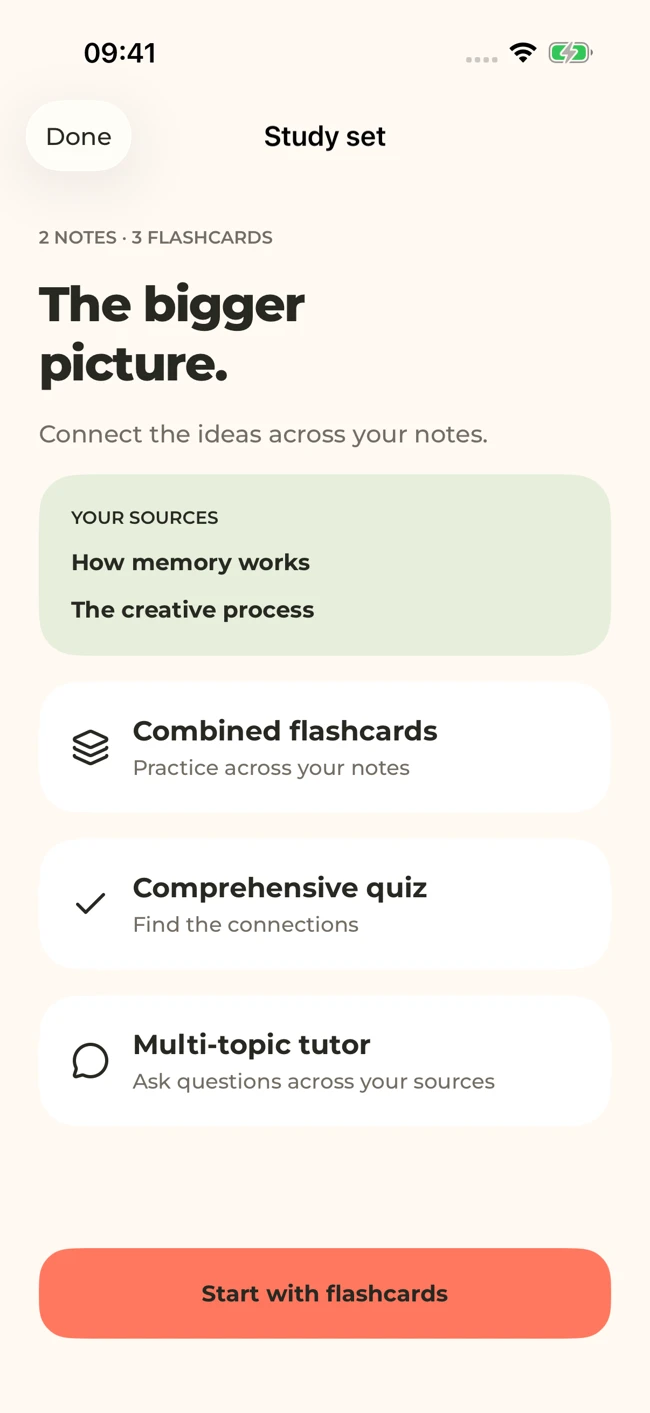
MelonNote can bring related notes into one study set. This iOS screen uses sample sources; layouts can vary by platform and version.
iPhone and Android · Features and screen layouts may differ.Use a separate worksheet for any correction you cannot make in your current app interface. This workflow does not assume MelonNote grades essays, validates citations or automatically maps cards to your exam rubric.
Turn your readings into evidence you can use.
Bring related source notes together in MelonNote. Check practice prompts about their claims and limits, then use them to plan and write an answer yourself.
Free download. In-app purchases available.
Turn the cards into an essay outline
Close the answers and spend a short, chosen interval planning the response. Here is one possible outline for the original fictional question:
- Thesis: Consider a further, measured extension rather than assuming permanent expansion is already justified.
- Demand: Source A records evening use, and Source B shows support among respondents.
- Qualification: Repeated entries and voluntary participation limit what those observations establish about all students.
- Resource objection: Source C identifies staffing needs but cannot quantify affordability.
- Judgment: A decision needs clearer information on distinct users, unmet need and staffing costs.
Now write one paragraph connecting a claim to evidence and a qualification. Do not paste three card backs together. Add the reasoning that explains why the evidence matters to the question.
Check the writing separately from the recall
After writing, ask whether the paragraph answers the assigned question, identifies its evidence accurately and explains the limitation without abandoning the argument. Compare your structure with the course rubric or an instructor-provided model.
A useful error log separates “forgot the evidence” from “remembered it but used it for the wrong claim.” The first may call for another recall session. The second calls for more selection and writing practice. You can use the essay-evidence worksheet to record both.
Common questions
Should I memorize an essay introduction?
You can practice concise openings, but a fixed introduction may not answer the actual prompt. Retrieve the ideas and evidence, then build an opening that fits the question's wording and scope.
How many flashcards do I need for an essay topic?
There is no useful universal count. Start with the claims, supporting evidence, important limitations and comparisons your course expects. Remove duplicate cards that do not test a new distinction.
Can flashcards replace timed essay practice?
No. Recall is one component of an essay. Practice selecting material, planning and writing under the conditions relevant to your assessment. For an exam with permitted resources, also see organizing open-book exam notes.
Check generated material against your original notes. App features, access limits, and screen labels can vary by platform and version.
Turn your readings into evidence you can use.
Bring related source notes together in MelonNote. Check practice prompts about their claims and limits, then use them to plan and write an answer yourself.
Free download. In-app purchases available.