Study biology diagrams in three passes: recall the labels, explain each arrow, then reconstruct the process without looking. A label tells you what something is. An arrow should tell you what moves, changes or connects. Being able to name the parts does not necessarily mean you can explain the process.
This guide uses an original simplified photosynthesis diagram and a partly blank version. The drawing is an editorial teaching aid, not an app screenshot. Its biological content is checked against the linked textbook sections; it deliberately leaves out molecular detail that may be required in your course.
Read the diagram's job before memorizing its labels
First decide what kind of representation you have. Is it showing location, sequence, transport, energy transfer or a relationship between variables? An arrow in a metabolic overview may mean something different from an arrow pointing to a cell structure.
Read the caption and legend. Check whether the diagram is drawn to scale, whether colors carry meaning and whether some steps are omitted. Write one sentence describing what the picture is intended to explain. That sentence becomes the boundary for your practice.
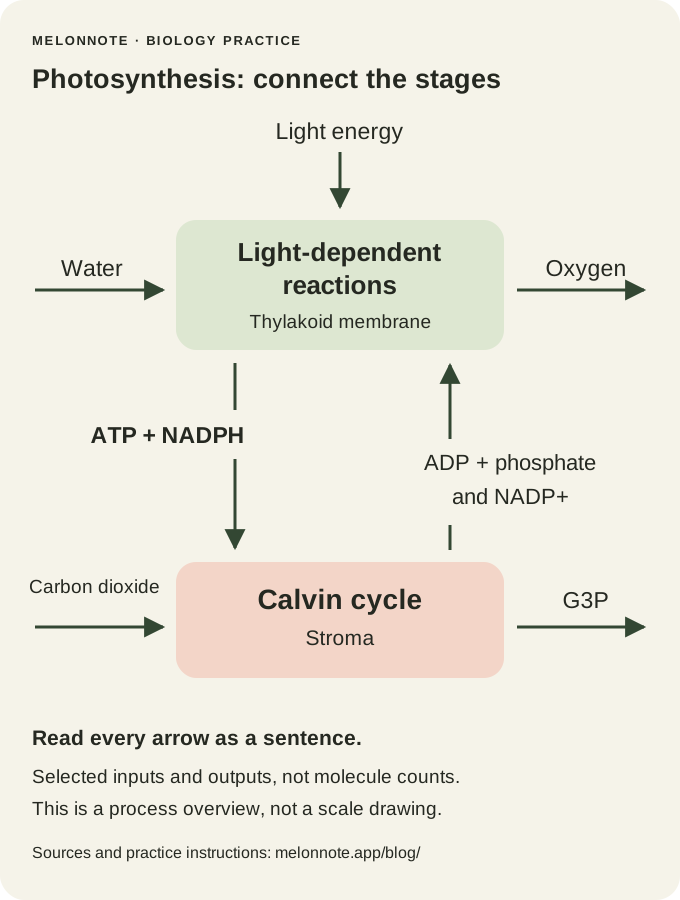
For our example: “This overview connects the light-dependent reactions with the Calvin cycle in a plant chloroplast.” It is not a complete picture of a chloroplast or a balanced chemical equation.
A source-checked photosynthesis overview
Light-dependent reactions occur at the thylakoid membrane. They use light energy to produce ATP and NADPH; water is used and oxygen is released. The Calvin cycle occurs in the stroma and uses carbon dioxide, ATP and NADPH to produce G3P, a three-carbon sugar phosphate. See OpenStax's overview for the relationship between these stages.
Pass one: retrieve the labels
Study the full diagram, then close it and open the partly blank practice version. On paper, fill the numbered spaces before checking the answer key below. The blank version preserves the shape so you can focus on the vocabulary first.
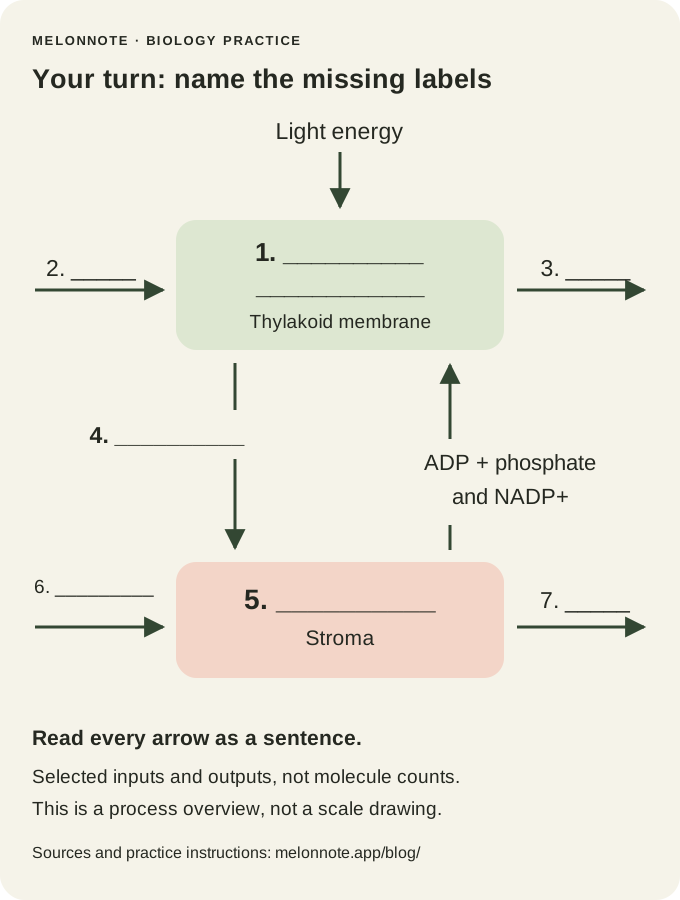
Answer key: 1. Light-dependent reactions. 2. Water. 3. Oxygen. 4. ATP + NADPH. 5. Calvin cycle. 6. Carbon dioxide. 7. G3P.
Do not mark the exercise complete simply because you placed all seven labels correctly. Now test what they mean in this diagram.
Pass two: explain the arrows
| Arrow or connection | Explanation to check |
|---|---|
| Water into light-dependent reactions; oxygen out | Water splitting supplies electrons; oxygen is released |
| ATP and NADPH toward the Calvin cycle | The cycle uses ATP and reducing power from NADPH |
| Carbon dioxide into the Calvin cycle; G3P out | Carbon is incorporated into organic molecules |
| ADP + phosphate and NADP+ returning | These forms can be used again in the light-dependent reactions |
The light-dependent reactions chapter explains water splitting and the production of ATP and NADPH. The Calvin cycle chapter explains carbon fixation and G3P production. Consult your course source for the required detail and terminology.
Cover the labels again and speak one complete sentence for each arrow. “Energy goes there” is too vague if you are expected to distinguish ATP, reducing power and carbon input.
Correct an attempt, not just the final picture
Here is a deliberately flawed editorial attempt:
Oxygen enters the Calvin cycle to become sugar. The light-independent stage happens only at night.
Correct it in two parts. The carbon input shown is carbon dioxide, not oxygen. “Light-independent” does not mean “night only”: the cycle depends on products of the light-dependent reactions. Do not preserve a misleading everyday interpretation of a technical label. The Calvin cycle source above discusses why the older “dark reactions” label can mislead.
On your own practice sheet, write the incorrect statement beside the correction and the source you used. That record is more useful than repeatedly tracing a now-perfect diagram without remembering what confused you.
Pass three: redraw with less scaffolding
On a new page, draw just two empty boxes. Add the stage names, locations and selected inputs and outputs from memory. Then compare with the full source. Your drawing need not resemble ours as long as its relationships are clear and accurate.
After checking, ask a different question: “Which part of this diagram accounts for the carbon in the organic product?” This shifts the task from visual familiarity to explaining a specific pathway. If your course expects exact stoichiometry or the intermediate reactions, this overview is only a starting point; practice that extra detail separately.
Use MelonNote for supporting questions
Add a clear, permitted photo or PDF of your course material and inspect the extracted note. Small subscripts, faint labels and lines crossing text can be misread. Keep the actual diagram available: extracted text may lose the spatial relationship that made it meaningful.
Generate supporting flashcards or ask the tutor a narrow question, such as “In this note, which stage uses carbon dioxide?” Check the answer in the source. Our biology flashcard examples focus on wording those text questions; the drawing and arrow exercises here address the visual component.
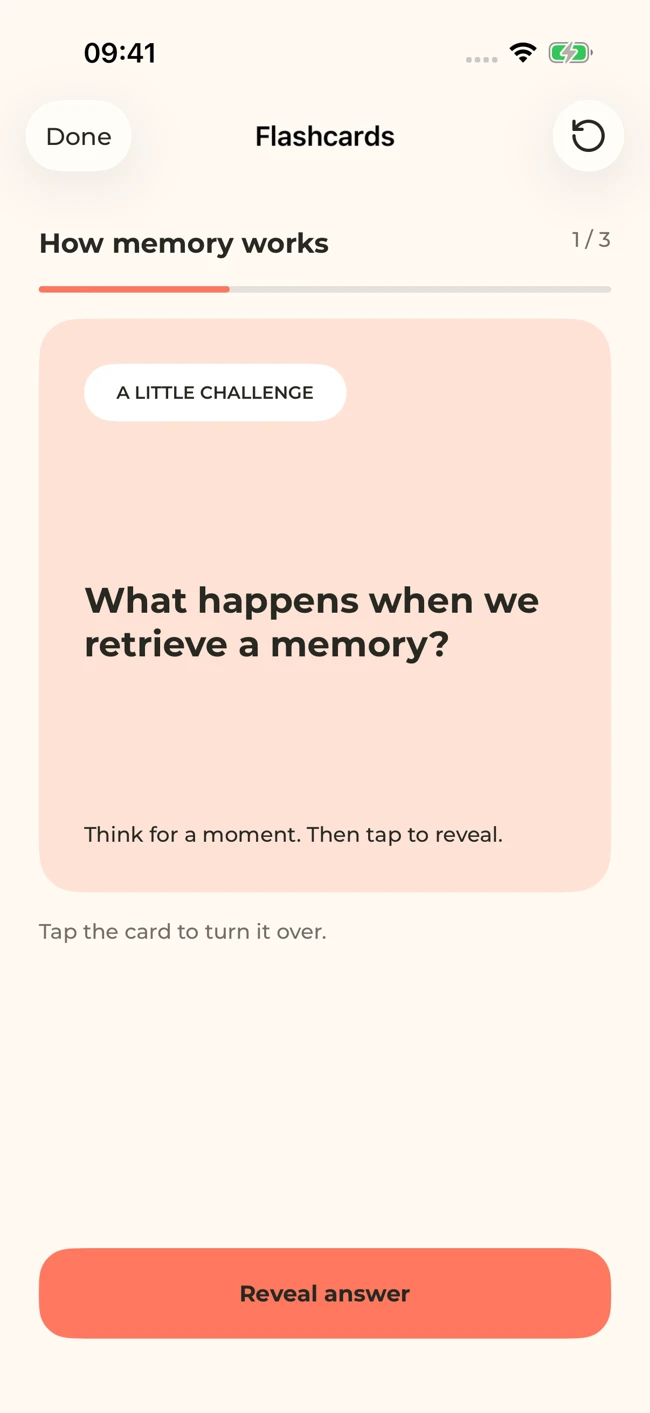
A MelonNote flashcard screen with sample study content. Attempt an answer before revealing it. Your generated questions will depend on your notes.
iPhone and Android · Features and screen layouts may differ.MelonNote's photo workflow can help you work with the material, but this guide does not claim automatic image occlusion or accurate interpretation of every diagram. Cover labels manually or use the blank illustration provided here. See photo-to-notes for capture checks.
Connect your diagram to questions you can answer.
Add a permitted, clear photo or PDF to MelonNote. Check the extracted terms and use supporting flashcards or tutor questions alongside your own drawing practice.
Free download. In-app purchases available.
Common questions
Should I copy a biology diagram repeatedly?
Copying can help you inspect a diagram, but include an attempt without the answer visible. Compare that attempt with the source and identify whether the error concerns a name, a location, a direction or an explanation.
What if I remember the labels but reverse the arrows?
Practice each connection as a sentence and a small isolated sketch. Name what enters and what leaves before rebuilding the full picture. A separate study-photo routine can help keep the source and your attempts organized.
Can a simple diagram replace the textbook figure?
Only for the specific relationships it preserves. Use the full figure when the course requires compartments, intermediate steps, molecule counts or other details omitted from a simplified overview.
Check generated material against your original notes. App features, access limits, and screen labels can vary by platform and version.
Connect your diagram to questions you can answer.
Add a permitted, clear photo or PDF to MelonNote. Check the extracted terms and use supporting flashcards or tutor questions alongside your own drawing practice.
Free download. In-app purchases available.