To make biology flashcards useful, give each card a clear job: retrieve a term, explain a process, distinguish two ideas or predict what happens in a stated situation. Keep the answer short enough to check, but preserve the conditions that make it correct.
The 15 examples below are original study prompts about introductory cell biology. They are examples of card design, not an exam-board syllabus or a complete revision deck. Check the terminology and depth expected by your course before adding them to your own study material.
Choose a narrow topic first
“Biology” is too broad for one useful first deck. Try “cell organelles and membrane transport.” Your learning objective might be to connect cell structures with their roles and explain movement across a membrane.
Collect the relevant lecture pages and notes. When your instructor uses a more detailed definition, keep that version as your study reference. A concise card should not erase a distinction the course expects you to know.
The structural examples draw on OpenStax Biology 2e: Eukaryotic Cells. The transport examples draw on Passive Transport. The wording below is adapted into short, original question-and-answer prompts.
Five cards for structures and terms
| # | Front: question | Back: answer |
|---|---|---|
| 1 | Where is most of a eukaryotic cell's DNA housed? | In the nucleus. |
| 2 | What do ribosomes make? | Proteins. |
| 3 | What distinguishes rough from smooth endoplasmic reticulum in appearance? | Ribosomes are attached to the rough ER. |
| 4 | What is a main role of the Golgi apparatus? | Modifying, sorting and packaging cellular products. |
| 5 | Which organelle carries out photosynthesis in plant cells that photosynthesize? | The chloroplast. |
The wording on cards 1 and 5 matters. “All DNA is in the nucleus” would ignore other cellular DNA. “Every plant cell has chloroplasts” would overgeneralize. Words such as most and that photosynthesize keep a short question from teaching the wrong absolute rule.
For terminology, one card can ask you to identify the structure. A later task should ask you to explain how the structure supports a function. Being able to say “Golgi” is not the same as explaining a cell's transport pathway.
Five cards for transport and sequence
| # | Front: question | Back: answer |
|---|---|---|
| 6 | What drives net diffusion down a concentration gradient? | Random particle motion produces a net movement from higher to lower concentration. |
| 7 | Does passive transport directly require cellular energy input? | No. |
| 8 | What distinguishes facilitated diffusion from simple diffusion across a lipid bilayer? | Facilitated diffusion uses membrane transport proteins. |
| 9 | What moves during osmosis? | Water across a selectively permeable membrane. |
| 10 | For nonpenetrating solutes, what happens to net water movement into an animal cell in a hypotonic solution? | Water moves into the cell; it may swell. |
Before rehearsing card 10, confirm that you understand the comparison between the solution and cell interior. A term such as “hypotonic” describes a relationship. Memorizing it as “water goes in” without the context leaves you vulnerable to a differently worded question.
For longer biological sequences, create a separate ordering exercise. Write the stages on blank paper, explain the transitions and then check your source. Several isolated cards do not automatically test whether you can connect an entire process.
Five cards for distinctions and applications
| # | Front: question | Back: answer |
|---|---|---|
| 11 | Does dynamic equilibrium mean particles stop moving? | No; movement continues without net movement in one direction. |
| 12 | How do diffusion and osmosis differ in scope? | Osmosis concerns water across a selectively permeable membrane; diffusion is broader. |
| 13 | If a membrane protein helps a substance move down its gradient, must the movement be active transport? | No; it can be facilitated diffusion. |
| 14 | Which two structures distinguish a typical plant cell from a typical animal cell in a basic diagram? | A cell wall and a large central vacuole. |
| 15 | Does recognizing a chloroplast's name show that you can explain photosynthesis? | No; the label and the mechanism are different learning tasks. |
The last card is a study check rather than a biological fact to memorize. It reminds you to ask what the assessment requires. A labeling question, a mechanism question and an experimental interpretation require different kinds of practice.
Turn a weak card into a useful one
Consider the front “Cell membrane?” with an answer containing an entire paragraph. You cannot tell which part of the paragraph counts as success. Replace it with a question such as “Why does facilitated diffusion need a transport protein for this substance?” and define the required answer from your course notes.
If a card contains three independent questions, split it. If splitting it destroys an important relationship, use one comparison question with a compact answer instead. Our comparison exercise helps when two concepts keep blending together.
Create cards from your biology notes in MelonNote
Import the relevant PDF or add a clear photo of the page you are studying. Check the resulting note against the source, particularly subscripts, arrows, abbreviations and negatives. Then use the flashcard feature to generate practice material.
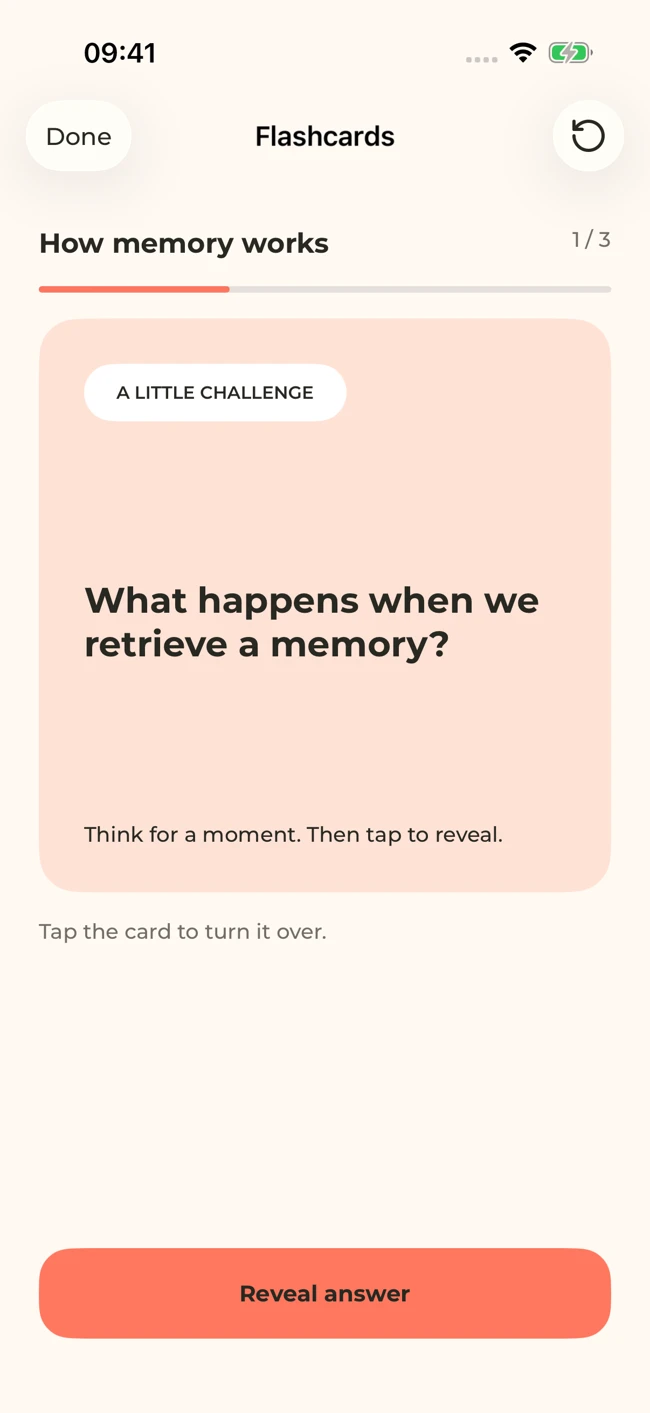
A MelonNote flashcard screen with sample study content. Attempt an answer before revealing it. Your generated questions will depend on your notes.
iPhone and Android · Features and screen layouts may differ.The screenshot shows sample app content; the biology prompts in this article are editorial examples. Generated cards can differ. Review each one against your lecture or textbook before treating it as something to learn.
Start with the PDF-to-flashcards workflow or photo import guide, depending on your source.
Build a deck from the biology you are studying.
Bring your lecture PDF or a clear photo of your notes into MelonNote, then review generated cards against your course source.
Free download. In-app purchases available.
Keep diagram practice separate
For spatial topics, redraw a simple diagram and label it from memory. Explain what each part does and how it relates to the neighboring structures. Compare with the source afterward. This is a separate exercise you can do on paper; it does not depend on an image-occlusion feature in MelonNote.
Use cards to support that exercise, not replace it. A question about an organelle's role can expose a conceptual gap that your drawing did not reveal.
Review your explanations, not only the score
Attempt an answer before revealing it. If you give a partly correct answer, name the missing condition. Keep difficult pairs together for a comparison task and revisit them in a later session.
When the explanation remains unclear, ask the AI tutor a focused question and check it against your source. For example: “I know facilitated diffusion uses a protein. Why is it still passive in this example?”
Build outward from material you can verify. Fifteen checked cards with clear answer boundaries are a better starting point than a huge deck you cannot yet judge.
Check generated material against your original notes. App features, access limits, and screen labels can vary by platform and version.
Build a deck from the biology you are studying.
Bring your lecture PDF or a clear photo of your notes into MelonNote, then review generated cards against your course source.
Free download. In-app purchases available.