To turn a lecture recording into flashcards, start with a checked transcript, choose one topic, then inspect the generated questions for coverage and accuracy. The useful result is a small set you can answer without the source open—not a card for every sentence someone spoke.
MelonNote can record audio and turn the resulting note into flashcards. This guide focuses on choosing and checking those cards. For microphone placement and the initial recording, use the lecture-recording guide. Always follow your class's recording and AI-use rules.
Start with a topic boundary, not the full hour
A lecture can contain an explanation, a digression, an administrative announcement and a correction to something said earlier. Treating every passage as equal study material makes a deck harder to trust.
Choose a boundary you can describe in one sentence: “These cards distinguish independent events from mutually exclusive events.” Keep the recording and transcript available so you can check qualifications. If the lecture moves into conditional probability afterward, give that section its own review pass.
Before generating anything, write two or three questions you expect the deck to answer. That gives you a coverage check independent of whatever the AI produces. A deck can contain correct facts and still omit the idea you actually need.
A short teaching script you can try
The following is an original editorial script. It is not a real student's transcript or a claimed output from MelonNote. You can read it aloud to make a short test recording of your own:
Independent events are events where knowing that one occurred does not change the probability of the other. Consider two independent tosses of a fair coin. The first toss landing heads does not change the second toss's probability of heads: it remains one half.
Mutually exclusive events cannot both occur in the same trial. On one coin toss, heads and tails are mutually exclusive. Be careful about the trial: heads on the first toss and tails on the second can both happen.
Independence and mutual exclusivity are different. If two events each have a positive probability and are mutually exclusive, knowing that one occurred makes the other impossible. Those events are therefore not independent.
Keep the assumptions with the example: fair coin, independent tosses, and a clearly identified trial. Removing them can change the answer. For your course, use its notation and definitions rather than relying only on this introductory exercise.
Check the transcript before checking the deck
Listen again wherever the transcript contains a negation, a fraction or a distinction between similar words. In this script, losing “not” from the final sentence would reverse the point of the lesson. Turning “one half” into “one” would also produce a confidently wrong card.
Use a three-item source check:
- Term: Does the transcript say independent or mutually exclusive?
- Scope: Is the sentence about one toss or two separate tosses?
- Condition: Does the statement retain the positive-probability qualification?
If a word is unclear, mark the passage as unresolved in your own review notes. Do not ask the app to guess what the lecturer must have meant. Our transcription-error checklist explains how to separate an audio problem from a subject question.
Convert the source into answerable questions
Open the checked note in MelonNote and use its flashcard tool. Review the result against a table like this one. These sample cards are editorial examples, not screenshots of generated answers.
| Source idea | Useful card front | Checked answer |
|---|---|---|
| Definition of independence | What stays unchanged when two events are independent? | The probability of one event after learning that the other occurred |
| Two-toss example | Given independent fair-coin tosses, what is the probability of heads on toss two after heads on toss one? | One half |
| Single-trial distinction | Can heads and tails both occur on the same coin toss? | No; they are mutually exclusive outcomes |
| Important qualification | Why are mutually exclusive events with positive probabilities not independent? | Once one occurs, the other's probability becomes zero rather than its original positive value |
The last card asks for reasoning. If its answer is too much for your current stage, split it into “What happens to the other's probability?” and “Why does that violate independence?” Keep the connection visible in your review notes.
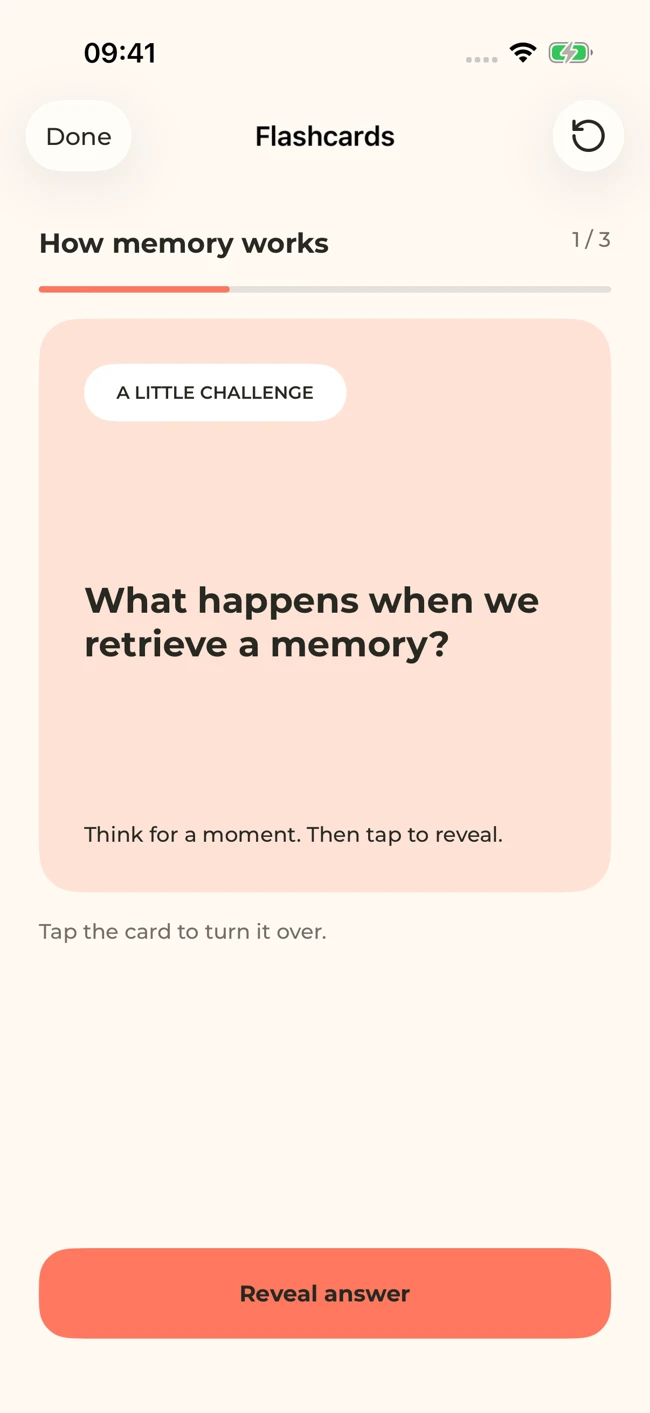
A MelonNote flashcard screen with sample study content. Attempt an answer before revealing it. Your generated questions will depend on your notes.
iPhone and Android · Features and screen layouts may differ.Repair a card that hides the distinction
An intentionally weak card might read:
Front: Are coin tosses independent?
Back: Yes.
That answer leaves the relevant events undefined. Replace your practice prompt with: “In a model of two independent fair-coin tosses, does seeing heads on toss one alter the probability of heads on toss two?” Now the assumptions and the task are explicit.
If your version does not offer the editing control you need, keep the corrected question in your own worksheet and exclude the flawed item from practice. The goal is a reliable review set, not preserving every generated card. See how to write better flashcards for more examples of overly broad prompts.
Give one lecture a useful second life.
Record a permitted explanation in MelonNote, check its transcript, then generate flashcards for one topic. Compare each answer with the source before reviewing.
Free download. In-app purchases available.
Check coverage in both directions
First move from each card back to its supporting sentence. Can you find the answer in the recording or another approved course source? If you cannot, label it as an extra claim to investigate.
Then move from the source to the cards. Does every important distinction have a question? In this example, a deck with ten definitions but no same-toss versus different-toss question would miss the most useful application.
Keep administrative reminders, jokes and unsupported guesses out of the deck. A lecturer saying “we will return to this next week” is a sign to leave the point open, not invent the missing explanation. You can use the recording-to-cards worksheet to track evidence and unresolved passages.
Review the idea with a new case
After answering the original cards, try this: on one fair six-sided die roll, are “rolling a two” and “rolling an even number” mutually exclusive? No: a two satisfies both. Are they independent? No: knowing the roll is two makes the probability of an even result one, compared with one half before that information.
Explain the change before revealing your answer. This checks whether you understand the distinction beyond the coin wording. If you cannot explain it, return to the source definition rather than generating another large deck.
Common questions about audio to flashcards
Can I upload any existing lecture audio file?
This walkthrough uses recording inside MelonNote. It does not establish support for every external audio format or import route. Check the options in your installed version before planning a workflow around an existing file.
Should every transcript paragraph become a flashcard?
No. Choose material that supports a course objective and can be checked. Some passages are better kept as explanations, worked problems or unresolved questions. The learning-objective worksheet can help decide what each question should test.
What if the recording and slides disagree?
Keep the disagreement visible and check for a later correction or ask your instructor. Do not merge two conflicting statements into a single confident answer. The recordings-and-slides workflow shows how to preserve separate sources while studying them together.
Check generated material against your original notes. App features, access limits, and screen labels can vary by platform and version.
Give one lecture a useful second life.
Record a permitted explanation in MelonNote, check its transcript, then generate flashcards for one topic. Compare each answer with the source before reviewing.
Free download. In-app purchases available.